Equals more then just fresh breath!
http://video.google.com/videoplay?docid=-3897137876292677387&q=mentos
http://video.google.com/videoplay?docid=5695044769427318137
Wednesday, May 24, 2006
Tuesday, May 23, 2006
National Geographic Photo: Camels
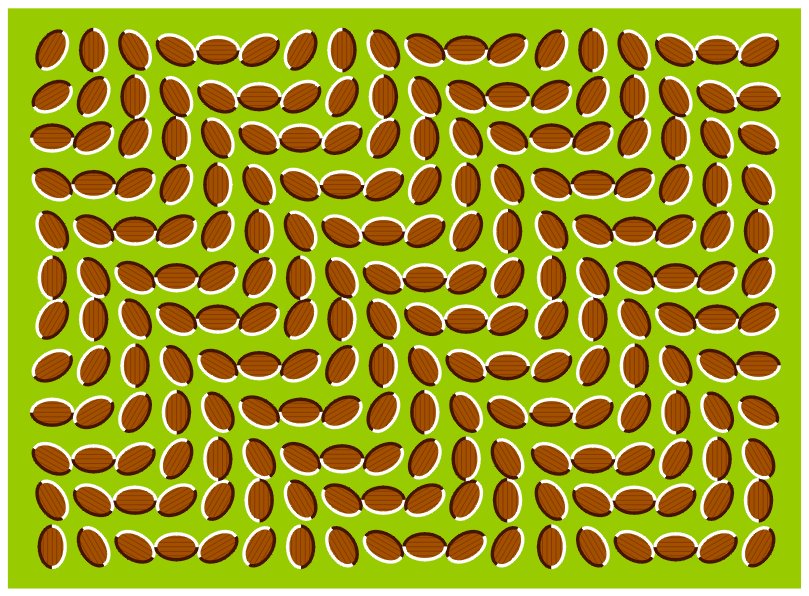
Can you tell what is special about this photo? Click on the photo to see a larger version. Can you see it?


Thursday, May 18, 2006
STOP what you are doing and go here NOW!
I clicked at least 40 times, and I just kept on going deeper and deeper.
Wicked.
http://interact10ways.com/usa/information_interactive.htm
Wicked.
http://interact10ways.com/usa/information_interactive.htm
Monday, May 15, 2006
What's better than free?
 If you haven't heard of Skype, you are alone. Really, it's the best thing to come along since sliced tomatos.
Skype is a a little program that you download for free. It's an instant messenger, and a mini-telephone company right in your computer.
Except, one difference: Calls to the US and Canada are FREE. Yup, free until the end of the year.
So, you are asking: "What would I do with this?" Well: Here's a few suggestions:
1. Ray: you can start using this from the basement office where your cell phone sucks.
2. Me: I can start using this when Becky is on the phone at home and I need to make a call.
3. Dad: you can call Becky and me for free.
4. Mom: you can call Becky and me for free.
5. Everyone else: you can call (you get the idea)
But, it got me, and I downloaded it. RIGHT AWAY. You can locate me at spkaine when you download it.
Wednesday, May 3, 2006
Would you kill someone to save yourself and 4 others?
Like scientists, philosophers use experiments to test their theories. Unlike scientists, their experiments do not require sophisticated laboratories, white-robed technicians or even rodents. They occur in the mind, and start with 'What if...'.
These "thought experiments" help philosophers clarify their understanding of certain concepts and intuitions. In the field of ethics, thought experimenters typically present a dilemma, examine the most popular "intuitive" response and then show the implications for real-world issues.
But such experiments are rarely tested on large numbers of people. So to reach a larger group, here are four typical experiments. Readers are invited to vote on how they think they would act in each case.
Here is a well-known example:
1. THOMSON'S VIOLINIST

To your horror, you discover that you have been kidnapped by the Music Appreciation Society. Aware of the maestro's impending death, they hooked you up to the violinist.
If you stay in the hospital bed, connected to the violinist, he will be totally cured in nine months. You are unlikely to suffer harm. No one else can save him. Do you have an obligation to stay connected?

The creator of the experiment, Judith Thomson, thinks the answer is "no". It would be generous if you did, she claims, but there is no obligation to stay, even if that means the violinist will die.
So how is this bizarre scenario related to the real world? Thomson used the experiment to show that a pregnant woman need not go to full term with her baby, as long as she had taken reasonable steps to avoid getting pregnant. It is thus a "pro-choice" argument.
The violinist represents the baby, and you - in the hospital bed - play the role of the mother. If you think unhooking yourself from the violinist is acceptable, but aborting an unwanted foetus is not, what are the moral differences between the two cases? In both situations, you could save a person by bearing a great burden for nine months.
One major flaw with thought experiments, especially in ethics, is that they are rarely tested on people. The sample size is minuscule. The philosopher will simply assume that most people think that one option is right (or wrong).
Philippa Foot, a renowned British philosopher, believed that if a doctor, about to save a patient's life with a large dose of a scarce drug, was suddenly interrupted by the arrival of five patients each in need of one fifth of the drug (without which death would be certain), then the doctor should give it to the five. It is, after all, better to let one person die than five.
Elizabeth Anscombe, another prominent philosopher, disagreed: "There seems to me nothing wrong with giving the single patient the massive dose and letting the others die". As these assumptions about people's intuition are central to the arguments of many philosophers, and as these assumptions can be tested, why not do so?
2. THE RUNAWAY TROLLEY CAR
One of the most famous thought experiments in ethics is "the runaway trolley". It aims to clarify how we should distinguish right from wrong.
Here is the scenario with two well-known variations.
3. THE FAT MAN AND THE TROLLEY CAR
Just before your leap, you realise that you are too light to stop the trolley. Next to you, a fat man is standing on the very edge of the bridge. He would certainly block the trolley, although he would undoubtedly die from the impact. A small nudge and he would fall right onto the track below. No one would ever know. Should you push him?
Philippa Foot would say that everyone ("without hesitation") would choose to flip the switch in the first trolley case, but that most of us would be appalled at the idea of pushing the fat man.
The philosophical puzzle is this: Why is it acceptable to sacrifice the one person in The Runaway Trolley Car but not in The Fat Man case? Can it ever be morally acceptable to kill an innocent person if that is the only way to save many? Should some actions - such as deliberately killing innocent people against their wishes - never be done? The last thought experiment explores this idea:
4. THE CAVE EXPLORERS
The high tide is rising and, unless you get out soon, everyone but Big Jack (whose head is sticking out of the cave) will inevitably drown. Searching through your backpack, you find a stick of dynamite. It will not move the rock, but will certainly blast Big Jack out of the hole. Big Jack, anticipating your thoughts, pleads for his life. He does not want to die, but neither do you and your four companions. Should you blast Big Jack out?
If the roles were reversed, what would you advise your trapped companions to do?
Thought experiments, although abstract, possibly implausible and open to different interpretations, can have important repercussions on the way we think and act as individuals. They raise thorny questions about morality in medicine, war, politics and indeed in everyday life.
Is there a difference between killing someone and letting them die? Are consequences all that matter, or are there some things we should never do, whatever the outcome?
By pointing out inconsistencies in our thinking, or simply encouraging us to reflect on issues we usually ignore, they can sharpen our intellect and enrich our moral lives. They also make for great conversation topics at the dinner table or at the pub. But be warned: you may lose friends as a result. And stay away from caves and bridges.
Sunday, April 30, 2006
Photo of the month: The Birthday Girl!

Watch out on NBC10 Philadelphia on Saturday or Sunday to see Kaitlyn on TV! Unfortunately, I took this shot yesterday - so it wasn't the one that will be on, but lets just say the one on TV will match her birthday theme very well.
View all 108 photos from April here.
Sunday, April 23, 2006
The most bizarre thing you will see this week, guaranteed
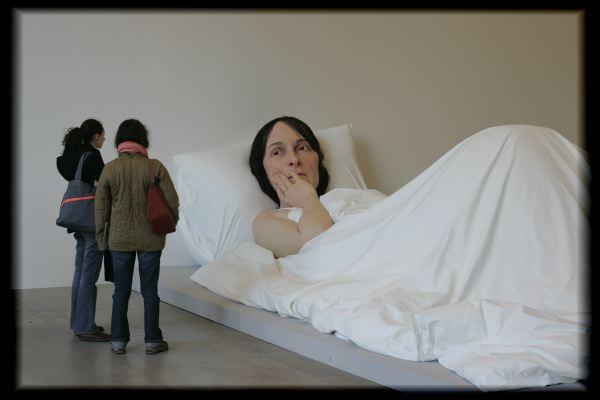 Life-like Ron Mueck figures on display at an art museum. These photos are pretty damn amazing.
http://www.washingtonpost.com/wp-dyn/content/gallery/2005/12/29/GA2005122900888_index_frames.htm?startat=1
More information at Wikipedia.
Tuesday, April 18, 2006
Bartering is still alive, at craigslist.com
 So, I was reading this article at CNN about a guy who wants to trade his red paperclip for a free house. Apparently, he's well on his way. Right now he has a house in Arizona free of rent for one year.
His blog is here. His myspace page is here.
I had no idea that Craigslist had a "barter" section, so I moseyed on over there and found this little gem:
Contractor willing to barter. on small jobs
Reply to: sale-145922903@craigslist.org
Date: 2006-03-28, 4:13PM EST
'i live in the mount pocono area . ive been in home improvements for a good 23 yrs i do most anything BUT SEPTIC SYSTEMS.''your shit is your problem"... anyway i do roofing ,siding, windows, and doors , drywall, painting , wallpaper, all types of flooring, yes even tile and hardwoods. i have a new house and a full basement. im looking for a nice bar .. bust be over 10' also im looking for a full size pool table . and i just got a boat from this site so im looking for boat electronics( depth /fish finder ect.. i also have 3 kids ages 5,4,and 3, they wanna go to disneyland.........i have over 2000 referances.. have a good day"
Gotta love PA!!
- actual link here
Sunday, April 16, 2006
Test your science knowledge
Why is the sky blue? Facts you should know
Take their quiz and see how you do.
1. What percentage of the earth is covered by water?
ROBERT GAGOSIAN, WOODS HOLE OCEANOGRAPHIC INSTITUTE
2. What sorts of signals does the brain use to communicate sensations, thoughts and actions?
TORSTEN WEISEL, ROCKEFELLER INSTITUTE, NEW YORK
3. Did dinosaurs and humans ever exist at the same time?
ANDREW C. REVKIN, NEW YORK TIMES SCIENCE REPORTER
4. What is Darwin's theory of the origin of species?
JONATHAN WEINER, 1995 PULITZER PRIZE-WINNING AUTHOR
5. Why does a year consist of 365 days, and a day of 24 hours?
LESLIE SAGE, NATURE MAGAZINE
6. Why is the sky blue?
ROY GLAUBER, 2005 NOBEL PRIZE WINNER; HARVARD UNIVERSITY
7. What causes a rainbow?
KIM KASTENS, COLUMBIA UNIVERSITY
8. What is it that makes diseases caused by viruses and bacteria hard to treat?
HELLE GAWRYLEWSKI, JOHNSON & JOHNSON (AND THE AUTHOR'S MOTHER)
9. How old are the oldest fossils on earth?
PAUL NURSE, 2001 NOBEL PRIZE WINNER; ROCKEFELLER INSTITUTE
10. Why do we put salt on sidewalks when it snows?
ARTHUR KNUDSEN, BRIDGETON, N.J., SCHOOLS
Extra credit: What makes the seasons change?
If this quiz wasn't as easy as you thought it would be, you're not alone. According to a recent National Science Board survey, 90 percent of Americans are interested in science, but only 15 percent consider themselves well-informed. In high schools, only 60 percent of students complete a general biology class, while only 40 percent complete a general chemistry class and a scant 27 percent complete a physics class, according to the National Center for Education Statistics.
Even if you did learn basic science in school, these questions might be tough to answer, according to O. Roger Anderson, professor of science education at Teachers College at Columbia University.
"People are so deeply involved in their family lives and professions," Anderson said. "How are they supposed to remember this stuff?"
Answers:
1. About 71 percent of the earth's surface is covered by water.
2. The single cells in the brain communicate through electrical and chemical signals.
3. No. Dinosaurs went extinct at the end of the Cretaceous period, 65 million years ago. Modern humans did not appear until around 200,000 years ago.
4. Darwin's theory of species origination says that natural selection chooses organisms that possess variable and heritable traits and that are best suited for their environments.
5. A year, 365 days, is the time it takes for the earth to travel around the sun. A day, 24 hours, is the time it takes for the earth to spin around once on its axis.
6. Solar radiation sunlight is scattered across the atmosphere by a process called diffused sky radiation. The sky is blue because much more short-wave radiation -- blue light -- is scattered across the sky than long-wave radiation -- red light.
7. Rainbows can be seen when there are water droplets in the air and the sun is shining. Sunlight, which contains all colors, is refracted, or bent, off the droplets at different angles, splitting into its different colors of red, yellow, blue, etc.
8. Influenza viruses and others continually change over time, usually by mutation. This change enables the virus to evade the immune system of its host so that people are susceptible to influenza virus infection throughout their lives. Bacteria mutate in the same way and can also become resistant if overtreated with antibiotics.
9. About 3.8 billion years; they're bacteria-like organisms.
10. Adding salt to snow or ice increases the number of molecules on the ground surface and makes it harder for the water to freeze. Salt can lower freezing temperatures on sidewalks to 15 degrees from 32 degrees.
Extra credit: Seasons occur because the earth is tilted at an angle of 23.5 degrees. At certain times of year the top half of the earth leans to the sun and therefore gets more sun and has summer. When that same half of the earth leans away from the sun it gets less light and has winter.

Sunday, April 2, 2006
Richard Petty Driving Experience
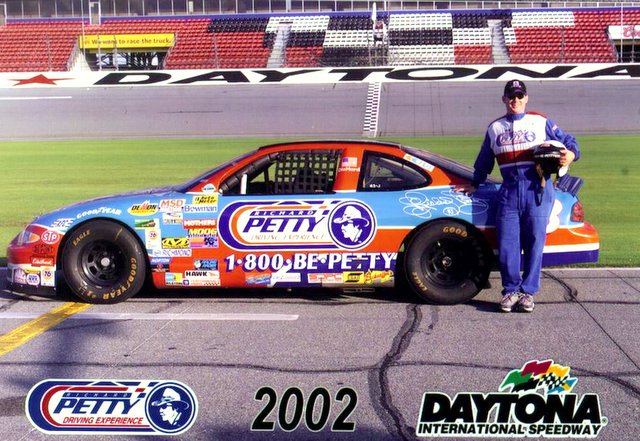
This was, without a doubt, the coolest thing I have EVER DONE. Ever. Ever. Did I say ever?
I was sitting at my desk tonight, and happened to look at this picture and had awesome memories of this trip:
-24 laps at Daytona International Speedway
-165 Miles Per Hour
This was my wedding gift from Becky. She bought the tickets, flew us down and watched as I drafted the instuctor around the world's most famous speedway.
Tuesday, March 28, 2006
Bald Eagle nest transmitted live
 Hornby Island, Bald Eagle Nest -- Vancouver BC
Someone stuck a camera in a tree, hooked it up to an encoder, and pointed it at a wild Bald Eagle nest. Strangely captivating.... Probably the closest any of us will ever get to one of these birds ;)
Link here
Talk about addicting!
Saturday, March 25, 2006


Paige: If you go on the potty, you can wear Big Girl Underwear!
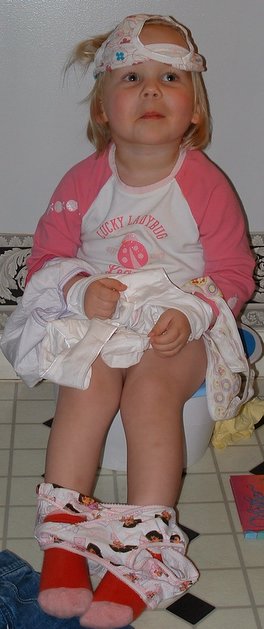
This is exactly how we found little Miss Paige today, dressed up in - go ahead and count: 7 pairs of Big Girl Underwear. You can tell she is trying not to smile while Beck and I are DYING!

Friday, March 24, 2006
Tuesday, March 21, 2006
Irish Diplomacy
 "The ability to tell someone to go to hell so that he will look forward to the trip."
--
Thanks Shawn for the picture message!
Do you know how I know that I'm gay?
Because I just bought Kelly Clarkson's new CD.
(not that there is anything wrong with being gay.)
I also bought the Nickelback CD, does that offset Kelly Clarkson?
Sunday, March 19, 2006

Image burned into my retinas
I fired the decorator. She re did the entire blog - but it was too dark for my liking, and I'm not paying her either.
I felt like reading the light-colored text on the dark background burned the words into my retinas. I know you felt the same way - thanks for not making me feel bad about it.
I felt like reading the light-colored text on the dark background burned the words into my retinas. I know you felt the same way - thanks for not making me feel bad about it.
Subscribe to:
Posts (Atom)